

Every public playground in the United States has to meet the Americans with Disabilities Act (ADA) standards, which means an accessible route to the play area, a set ratio of ground-level to elevated play components, and firm, stable safety surfacing. Compliance is the legal floor. An accessible or inclusive playground goes further and is designed so children who use wheelchairs or have sensory differences can play alongside everyone else.
This guide covers what compliance actually requires, how to calculate your component ratios, when ramps become mandatory, and what separates a compliant playground from a genuinely inclusive one.
What makes a playground ADA compliant
Compliance comes down to a handful of measurable requirements from the 2010 ADA Standards for Accessible Design. If you can document each one, you're in good shape.
Here's what a compliant play area needs:
An accessible route must connect the play area to the site's arrival points and run continuously to the equipment, with no steps or abrupt level changes.
Ground-level components on that route must meet a minimum count and variety based on how many elevated components you have.
At least half of your elevated components must sit on an accessible route, reachable without navigating a barrier.
Compliant safety surfacing must be firm, stable, and slip-resistant throughout the accessible route and use zones.
Transfer systems or ramps must serve elevated structures, with the choice between them determined by component count.
The ADA defines an accessible route as a continuous, unobstructed path connecting all accessible elements and spaces of a play area. Routes inside the play area generally need 60 inches of clear width, though 36 inches is permitted in specific limited conditions. Getting the route right is usually the least expensive part of compliance and the part most often missed.
How many ground-level components do you need
The count depends entirely on your elevated components, and the ADA publishes a fixed table. Ground-level components are play items a child can reach and use without going up or down, like swings, spring riders, diggers, and activity panels. Elevated components sit above or below grade on a deck or platform.
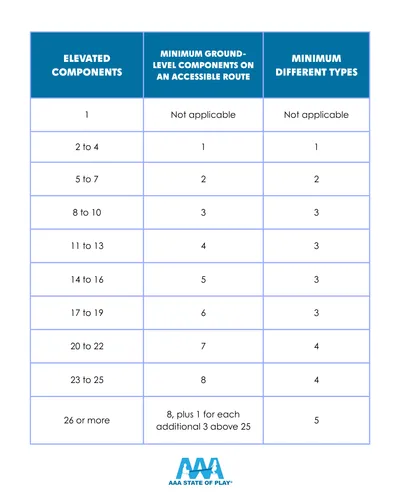
Count carefully during the design phase, because adding a deck late in the process can push you into a higher bracket and require another ground-level component you didn't budget for. The variety requirement matters too: three swings count as one type, not three.
When does a playground need ramps
Ramps become mandatory at 20 elevated components. Below that threshold, transfer systems are an acceptable way to connect elevated play, letting a child move from a wheelchair onto a transfer platform and then through the structure. At 20 or more elevated components, at least 25 percent of them must be on an accessible route served by a ramp.
Transfer systems satisfy the law without serving every child. A transfer requires upper body strength and the willingness to leave a mobility device behind, which rules out a meaningful share of wheelchair users. Ramps let a child stay in their chair and reach elevated play the same way their friends do.
Adding ramps beyond the minimum is one of the highest-value upgrades available. Accessible play structures built around ramped decks open the whole structure rather than a corner of it, which changes where a child can go and who they can play with once they're up there.
What surfacing meets accessibility requirements
Surfacing has to satisfy two separate standards at once, and this trips up a lot of projects. ASTM International standard ASTM F1951 covers accessibility of surface systems, meaning firmness and stability under a wheelchair. ASTM F1292 covers impact attenuation, meaning the surface actually cushions a fall.
Materials that meet both include engineered wood fiber, rubber mulch, and poured-in-place rubber. Loose-fill options generally need a minimum installed depth of 12 inches and require regular raking to stay compliant, since a compacted or displaced area fails the firmness test. Poured-in-place rubber costs more upfront and needs no depth maintenance.
Sand and pea gravel do not meet accessibility requirements. They can still appear on a site as a sensory play element, but they can't serve as the surface on an accessible route. Choosing playground surfacing early keeps your borders, drainage, and budget aligned with the standard you have to hit.
What's the difference between ADA-compliant, accessible, and inclusive
These three terms describe different levels, and the industry uses them loosely enough that clarity helps. Compliance is required by law on public playgrounds at parks, schools, and homeowners associations. Accessibility and inclusion are voluntary steps past it.
ADA-compliant means the play area meets the minimum legal requirements for routes, ratios, and surfacing.
Accessible describes equipment designed for wheelchair use throughout, with ramps instead of stairs and specialized swings and spinners.
Inclusive goes further and serves children with sensory differences, vision impairments, and cognitive disabilities alongside physical ones.
An inclusive playground has no separate section for children with disabilities. All the equipment is designed to challenge kids across a range of abilities in the same space, and many inclusive designs also accommodate adults with mobility limitations who are supervising. The ADA never defines "accessible" or "inclusive," which is why a compliant playground can still leave children out.
How do inclusive swings and slides change the play experience
Inclusive equipment gets more children onto the same piece of equipment at the same time, which is where social play happens. A child watching from the perimeter isn't playing, no matter how compliant the site is.
Swings do particular work for children with autism. The repetitive motion provides vestibular input that helps with sensory processing and often has a calming effect, which is why accessible swings and seats with high-back and harness designs show up on most inclusive sites. Wide slides that allow a caregiver or sibling to ride alongside serve a similar purpose.
Both types build motor skills and coordination for every child who uses them. The benefit isn't limited to the children the equipment was designed for, which is the practical argument for inclusive design over segregated equipment.
Why do sensory activities belong on an inclusive playground
Sensory play gives children a way to engage that doesn't require climbing, running, or competing. That matters for children with autism and for any child who finds a busy playground overwhelming, and it broadens what your site can offer without adding fall height.
Effective sensory elements are usually simple. Musical play equipment like chimes and drums invites experimentation with sound and works from a seated position. Tactile panels, textured surfaces, and sand play tables at accessible heights support cooperative play while giving kids something to touch and manipulate.
Variety is the goal. A site with climbing, swinging, spinning, sound, and tactile options lets every child find an entry point, which is a better test of inclusion than any single piece of specialized equipment.
Can you get funding help for an inclusive playground project
Yes, and grant funding is worth pursuing before you cut scope. Nonprofits like KaBOOM! offer grants and planning resources aimed specifically at building safe and inclusive play spaces, and many states run recreation grant programs through their parks departments.
Financing is another route. AAA State of Play offers financing options, which can let you install the ramped structure and the poured-in-place surfacing now rather than phasing them across two budget years. Compliance requirements apply either way, so building the accessible version once usually costs less than retrofitting later.
Build an accessible playground with AAA State of Play
AAA State of Play carries a full range of ADA accessible commercial playground equipment, including ramped structures, wheelchair accessible swings and spinners, ground-level play components, and compliant surfacing. Our specialists can review your component counts and routes to confirm your design meets ADA standards before you order. Request a free quote today!