
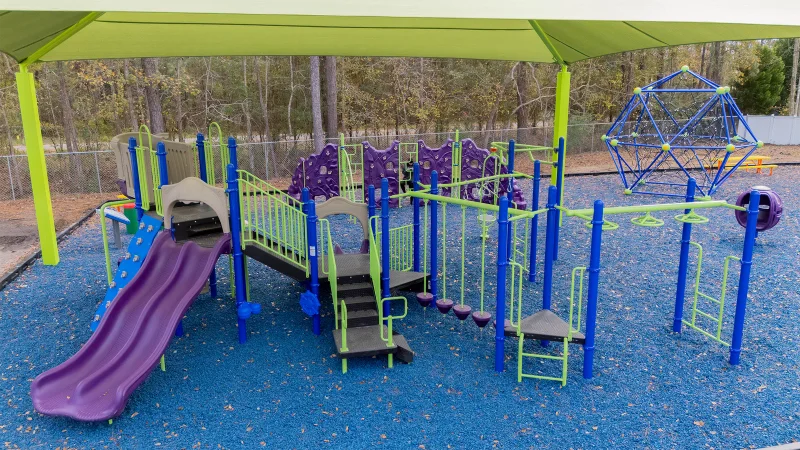
Client: Coastal Autism Academy
Location: Myrtle Beach, South Carolina
Project: Outdoor playground installation
Partner: AAA State of Play
Site: 116 x 60 feet
Population: Students ages 5–19, varying degrees of autism
Completed: 2024
At a Glance
Project designed within existing DSS-aligned funding. No additional review cycles required.
Equipment configuration spans ages 5 through 19, including young adults with varying degrees of autism.
Site dimensions and budget confirmed before design started. No late-stage scope changes.
Poured-in-place surfacing evaluated and rejected early due to cost overrun risk.
Final configuration maximized age-appropriate equipment inside fixed footprint and funding limits.
The Problem
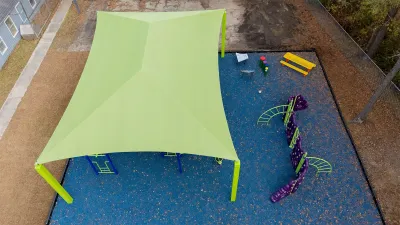
Coastal Autism Academy needed an outdoor playground. The project looked simple until you got into the details.
The school serves students with autism across a fourteen-year age range. Five-year-olds through nineteen-year-olds. That's not a typical elementary playground population. Equipment that holds the attention of a second grader won't do much for a teenager. And equipment designed for neurotypical kids doesn't always translate to students who process sensory input differently.

The site measured roughly 116 by 60 feet. Enough space to work with, but not enough to waste. Every decision about equipment placement and safety zones had to account for the actual square footage available.

Then there was the funding.
Money was already secured before AAA State of Play got involved. That sounds like good news. It was. But the budget came with oversight. Funding was subject to internal organizational review connected to South Carolina Department of Social Services. DSS-aligned money means documentation. It means scrutiny. It means that any significant change to project scope or cost could reopen the approval process and invite questions nobody wanted to spend three months answering.
The academy didn't need a playground that looked good in a proposal. They needed one that would actually get built. On time. Without budget complications that could stall the project or create friction with their funding source.
“We felt the autism community was underserved and had greater needs, so we made the transition to focus entirely on serving children with autism.”
— Mike, Owner, Coastal Autism Academy
The Constraint
The budget ceiling was fixed. Not "we'd prefer to stay under this number." Fixed.
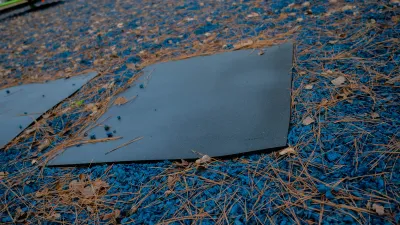
That created a specific problem. The natural upgrade path for a project like this would be poured-in-place rubber surfacing. It looks cleaner. It lasts longer. Administrators tend to like it. It also costs significantly more than alternatives.
The math didn't work. Poured-in-place would have pushed the project past its approved budget. At that point, the academy would face two options. Cut equipment to offset the surfacing cost, or go back to DSS for additional funding.
Both paths carried risk.
Cutting equipment means delivering less to students who needed more, not less. For a population spanning ages 5 to 19, a reduced equipment scope almost guarantees that part of the student body gets underserved. You either skew young and leave the teenagers with nothing, or skew old and lose the elementary kids.
Requesting additional DSS funding means reopening approvals. That introduces delay. It invites scrutiny. It creates the possibility that the answer comes back as "revise your scope" or "request denied." For a project that already had momentum and secured funding, that path wasn't worth the risk.
The constraint went beyond budget. The playground had to fit a fixed footprint, serve the full age range, stay within approved funding, and avoid creating administrative problems after the fact.
“This was our first time purchasing this type of equipment, and having a team that could walk us through every step was incredibly important.”
— Doris, Executive Director, Coastal Autism Academy
The Decision
AAA State of Play made a call early in the process: design within the existing budget and footprint. No exceptions. No "let's see if we can get a little more funding." No premium upgrades that would push costs past the ceiling.
That meant no poured-in-place surfacing. It meant no material upgrades that sounded good but didn't fit the budget reality.
The team worked backward from what was actually available rather than forward from what would be ideal. The question became: how do you configure a 116 by 60 foot space to serve a five-year-old and a nineteen-year-old equally well? How do you support students with different sensory needs without custom fabrication that blows the budget?
The rejected option was clear. Poured-in-place surfacing and higher-cost materials. The reason was equally clear. Those upgrades exceeded available funding by a margin that would have forced either scope reduction or a return to the approval process. Neither outcome served the client.
What Was Executed

Before design work started, the AAA State of Play team confirmed three things with Coastal Autism Academy.
Site dimensions. The playground had to fit 116 by 60 feet. That number came from actual measurement, not assumption.
Age range. Students ages 5 through 19 would use the space, including young adults with varying degrees of autism. Equipment selection had to account for that spread from the start.
Funding parameters. Budget was secured but subject to DSS review. Any cost increase would require justification to people outside the design process.
Locking these details early shaped everything that followed. There were no surprises at the 80% mark. No uncomfortable conversations about cost overruns. No redesigns because someone realized the space was smaller than expected or the funding had conditions nobody mentioned.
The final configuration prioritized equipment selection over surface upgrades. Play structures were chosen for their ability to engage older students, not just elementary-age kids. Layout used available square footage efficiently without wasting space on oversized safety zones.
Surfacing stayed within budget using compliant materials rather than premium alternatives. The project moved through internal review without triggering additional DSS oversight.
“They supported us in every decision, from the colors to the equipment selection and how each piece could be used.”
— Doris, Executive Director, Coastal Autism Academy
“The design reflects a strong therapeutic understanding of autism and provides a sensory-appropriate experience for the children.”
— Mike, Owner, Coastal Autism Academy
What Is True Now
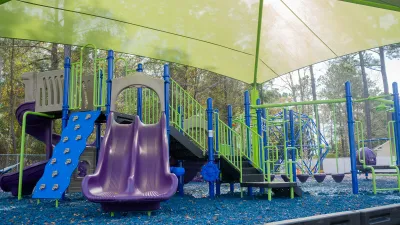
The playground was designed, approved, and installed within the original budget.
No scope reductions. The equipment configuration serves the full age range as planned.
No funding complications. The approved budget held. DSS review proceeded without additional requests.
Coastal Autism Academy has an outdoor play environment that serves students from kindergarten age through young adulthood. That's a population most standard playground configurations ignore.
The project moved forward because constraints were confirmed before design work began. Site dimensions, age requirements, and funding parameters were treated as fixed inputs rather than flexible targets. That eliminated the most common sources of delay and cost overrun in institutional playground projects.
For schools and organizations working with oversight-heavy funding sources, avoiding reopened reviews can be the difference between a project that gets built and one that gets stuck in revision cycles.
“For the kids, it’s going to be over-the-top exciting. They’ve never had anything like this before.”
— Mike, Owner, Coastal Autism Academy
“Everything about this space reflects thoughtful planning around the needs of the children it serves.”
— Jocelyn, Statewide Placement Services Director, SC DSS
About AAA State of Play
AAA State of Play designs and installs playground equipment for schools, municipalities, and organizations where the stakes of getting it wrong are real. The company works with clients who need careful alignment between available funding, site constraints, and the specific needs of the population being served.