
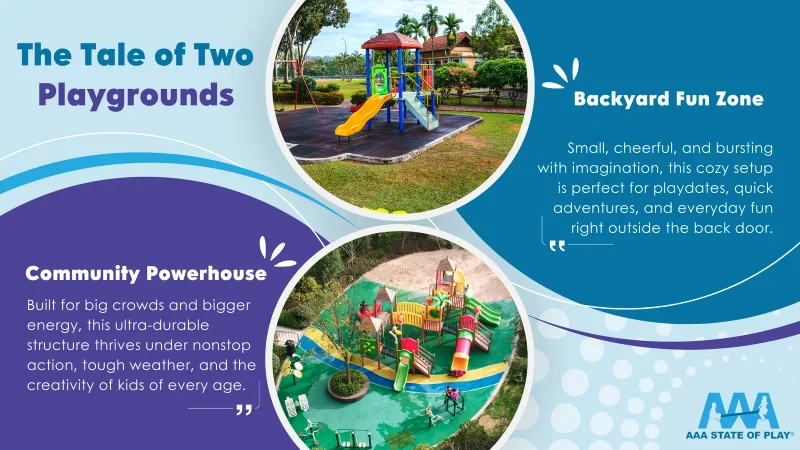
If you’ve ever wondered why the slide at the local park looks like it could survive a tornado, but the slide in your neighbor’s backyard trembles when a kid climbs the ladder, you’re in the right place. When you compare commercial vs residential playground equipment, the differences aren’t just noticeable—they’re foundational. To the untrained eye, both types of playgrounds may seem similar, but beneath the paint, panels, and play features? You’re looking at two entirely different worlds.
It helps to see those differences side by side—because nothing highlights the contrast like looking at how each playground is built, who it’s built for, and how it’s meant to be used.
That visual tells the story well, but it’s only the beginning. At AAA State of Play, we’ve supplied playgrounds of every size, style, and setting for decades. Schools, parks, HOAs, churches, daycares, backyards—you name it, we’ve helped bring it to life. And after all those installations, one question pops up more than almost any other: What actually makes commercial playground equipment different from residential equipment?
Let’s break it down clearly, confidently, and with a little fun, because the difference is bigger than the tallest slide.
Same Idea, Different Universe: Why Purpose Changes Everything
When it comes to commercial vs residential playground equipment, everything starts with purpose. Residential playgrounds are built for small-scale play—just a few kids at a time, usually siblings or neighborhood friends, enjoying simple, everyday fun.
Commercial playgrounds operate on an entirely different level. They’re designed for crowds: full classes at recess, packed parks on weekends, and kids of all ages and abilities cycling through nonstop. That means they must be tougher, safer, more inclusive, and built to handle constant, unpredictable action.
In the end, residential equipment supports personal backyard moments; commercial equipment powers full community play. And that mission difference shapes everything else.
Safety Rules the Playground: Where Standards Split Fast
When you look at commercial vs residential playground equipment, one of the biggest differences jumps out in the rulebook. Backyard sets don’t have to meet the same strict safety standards as public playgrounds. Many are well-made, but the oversight simply isn’t as intense.
Commercial playground equipment, on the other hand, plays in a regulated arena. It must meet rigorous requirements like:
- ASTM F1487 for public-use equipment
- CPSC playground safety guidelines
- ADA accessibility standards for inclusive play
These aren’t optional checkboxes—they’re mandatory for schools, childcare centers, municipalities, churches, and anyone responsible for public spaces.
Why does it matter? Because commercial playgrounds must protect dozens or even hundreds of kids every day. Safety isn’t just a feature; it’s the foundation. Understanding that distinction is key to knowing why commercial equipment is built the way it is.
Materials & Durability: Why Commercial Playgrounds Last Longer
A quick way to tell the difference? Just examine the materials the equipment is made of.
Residential playgrounds typically use wood or thinner-gauge steel. They’re built to be installed quickly, last several years, and withstand casual use.
Commercial playgrounds, however, use industrial-grade materials such as:
- Powder-coated, heavy-gauge steel
- Rotationally molded plastic components
- Reinforced, vandal-resistant panels
- High-density polyethylene (HDPE) climbers and barriers
These materials can withstand extreme weather, high foot traffic, UV exposure, and—let’s be honest—the creative ways kids try to test physics on a playground.
AAA State of Play prioritizes durability because long-term value matters. A commercial playground isn’t just a purchase—it’s an investment a community will rely on for decades.
Design & Engineering: More Than Just Slides and Swings
When comparing, the design differences show up fast. Residential sets tend to keep things simple: a slide, a swing beam, maybe a small climber or playhouse. Perfect for a few kids and a backyard afternoon.
Commercial playgrounds, though, are a whole different level of engineered fun. They’re built for variety, flow, and developmental value—because dozens of kids are playing at once, all in different ways.
Commercial designs consider things like:
Age-appropriate challenges
Toddlers, preschoolers, and big kids need different heights, features, and play experiences that support safe exploration.
Smooth traffic flow
Layouts are intentionally crafted to prevent bottlenecks, collisions, and those “everyone wants the same slide” moments.
Inclusive and accessible play
Ramps, transfer points, sensory panels, wide pathways, and ground-level activities make sure every child can join the fun.
Developmental depth
From physical coordination to imagination and social interaction, commercial playgrounds layer in play value far beyond the basics.
These thoughtful elements create richer, safer, more inviting play spaces—the kind that only commercial environments truly require.
DIY vs. Done-Right: Why Install and Upkeep Tell the Real Story
Another big difference in commercial vs residential playground equipment shows up long before the first child takes a climb: how each type is installed, maintained, and built to last.
Residential playgrounds are usually a weekend project. A few basic tools, a couple of YouTube tutorials, and some determination can get a backyard set standing. Maintenance stays simple too—tighten a bolt here, refresh the stain there, and you’re good to go.
Commercial playgrounds, however, live in a different universe.
Installation
These structures require professional installation or certified oversight. Every post must be perfectly anchored, leveled, secured, and inspected to meet strict public-use safety standards. When entire classes or crowds will be using it daily, precision isn’t optional.
Maintenance
Public playgrounds need regular checkups—hardware tightening, surfacing inspections, wear assessments, and safety reviews. It’s essential for long-term safety and reduces liability for schools and communities.
Lifespan
A solid residential set may last 5–10 years. A well-maintained commercial playground can last 15–20+ years, often far beyond that.
In short, residential equipment is built for convenience; commercial equipment is built for endurance. And that difference makes all the difference once real-world play begins.
Cost Differences: Why Commercial Systems Cost More (and Why It’s Worth It)
When comparing commercial vs residential playground equipment, one difference becomes obvious fast: the price. Commercial playgrounds cost more—but there’s a good reason they do.
Commercial structures are built from stronger, heavier materials designed to handle constant, all-day use. They must meet stricter safety and accessibility standards, support a much longer lifespan, and be installed with professional precision. They also require engineering that anticipates everything from heavy foot traffic to unpredictable kid-led creativity.
Residential playgrounds are built for casual backyard fun. Commercial playgrounds are built for the everyday reality of schools, parks, and communities—places where safety, durability, and reliability absolutely matter.
So while the upfront investment is higher, the payoff is long-lasting: equipment that stands strong through years of enthusiastic play and protects every child who climbs, swings, and explores.
Build for Today, Play for Years: Choose the Playground That Truly Lasts
Residential and commercial playground equipment may share the same spirit of fun, but they’re built for entirely different worlds. When you’re planning a playground for a school, park, HOA, church, or any community space, commercial-grade equipment delivers the safety, strength, and long-term value those environments demand.
At AAA State of Play, we make it easy to bring your vision to life—with turnkey support from design to delivery to installation. Whether you’re dreaming of a compact play structure or a full-scale playground environment, we’re here to guide every step of the journey.
If you’re ready to create a play space that lasts for generations, explore our commercial playground solutions and discover what’s possible.
Contact us today to start building your next great playground.
Keep the Play Going: Explore These Helpful Resources
- Designing Your Ideal Commercial Playground: A Comprehensive Guide
/designing-your-ideal-commercial-playground-a-comprehensive-guide/ - How Are Playgrounds Made?
/how-are-playgrounds-made/ - A Playground Safety Guide
/a-playground-safety-guide/ - How-To Playground Safety
/how-to-playground-safety/ - Safety Features for Preschool Playgrounds
/safety-features-for-preschool-playgrounds/ - Infant and Toddler Playground Equipment: Foster Growth Through Discovery
/infant-toddler/