
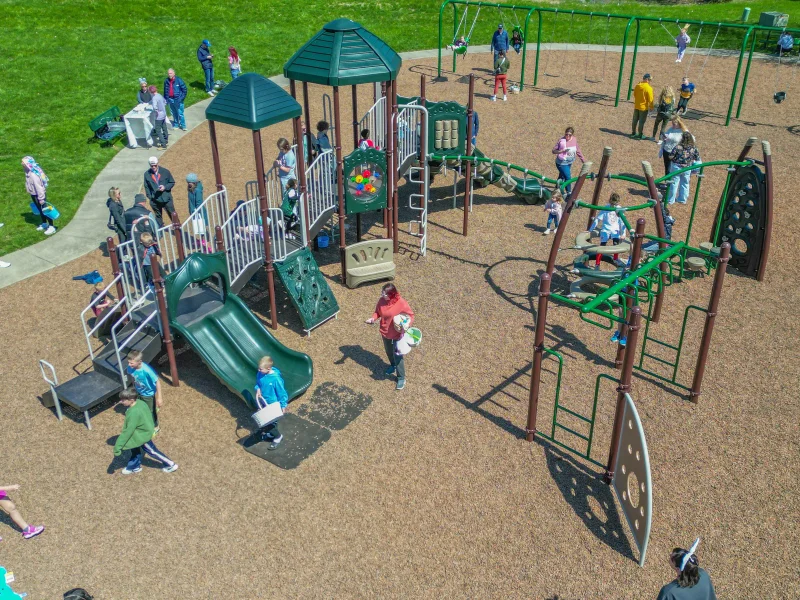
The Buyer: HOA Boards Making Playground Replacement Decisions
HOA boards do not purchase playground equipment the way private buyers do. They approve capital decisions that remain visible for years and are evaluated by residents, future homeowners, and future boards.
Once a playground replacement is approved, the outcome becomes permanent. If the decision creates safety issues, coordination problems, or long-term maintenance challenges, responsibility does not disappear with installation. It stays with the board.
As one Windermere HOA board member described it:
“They were experienced working with HOAs, which have multiple opinions, and they also understood our budget.”
That governance reality framed every part of this decision.
The Problem: Aging HOA Playground Equipment and Rising Liability
Windermere HOA’s existing playground was installed in the early-to-mid 1990s. While it had served the neighborhood for decades, the equipment had aged significantly and no longer aligned with modern safety expectations, usage demand, or amenity standards.
The playground sits adjacent to the community pool, making it a highly visible and heavily used space. Incremental repairs would not address long-term safety exposure or deliver the amenity value residents expected.
As the HOA president explained:
“Our playground equipment was original from when the community was built back in the mid-90s, so it was in desperate need of repair and time to update.”
The board needed a decision that solved the problem completely — not temporarily.
The Constraint: HOA Governance, Budget Approval, and Long-Term Accountability
HOA playground replacement decisions operate under constraints that are structural, not optional:
Multiple board members and viewpoints
Fixed budgets
Formal approval processes
Public visibility
Long-term accountability
The risk is not whether execution variables exist — they always do.
The risk is whether those variables return to the board after approval.
Windermere HOA’s priority was to avoid becoming the owner of downstream execution issues.
The Decision: Full Playground Replacement with a Single Accountable Vendor
Windermere HOA chose to fully remove the existing playground and replace it with a new play space, selecting one accountable vendor responsible for the entire outcome.
That responsibility included:
design coordination
equipment procurement
installation execution
overall outcome integrity
The board prioritized a local partner with direct experience working within HOA governance structures, timetables, and budget constraints.
As the HOA president stated plainly:
“We picked you mainly because you’re a local vendor and you’re a one-stop shop for us, from purchasing the equipment and design to installation.”
This decision eliminated fragmented responsibility before it could create risk.
What HOA Boards Avoided: Fragmented Vendors and Partial Repairs
The board explicitly avoided approaches that would increase long-term exposure, including:
patching or partially upgrading aging equipment
splitting responsibility across designers, suppliers, and installers
forcing the HOA to coordinate or arbitrate between vendors
Those paths often create fragmented accountability, where issues surface later and responsibility becomes unclear.
As one board member noted when describing the condition of the old playground:
“We had a very nice playground that was built in the early 90s, but it did not age very gracefully.”
The board recognized that partial solutions would only defer risk, not remove it.
Why Fragmented Playground Vendors Increase HOA Risk
Fragmented responsibility rarely fails immediately. It fails over time — when maintenance issues arise, when residents ask questions, or when future boards inherit unresolved decisions.
For HOA boards, the most defensible decisions are those where accountability is singular and explicit. Consolidating responsibility protects governance and reduces long-term exposure.
Windermere HOA’s decision reflected that principle.
What Changed After the Playground Replacement
Following completion:
The playground was fully replaced and opened for use
The space functions as a central neighborhood amenity tied to pool traffic
Children from Windermere and surrounding communities use the playground daily
The project contributes to neighborhood appeal and long-term value
HOA leadership publicly recommends the vendor and the decision
As the HOA president summarized:
“It’s a big amenity for our neighborhood. For other HOAs, it’s an investment that will pay off over time.”
These outcomes reflect decision durability — not short-term execution success.
Why This HOA Playground Decision Matters for Other Boards
HOA boards cannot eliminate execution variables. They can eliminate uncertainty around who carries responsibility for them.
Windermere HOA’s approach demonstrates a repeatable decision framework:
Full replacement reduces long-term risk
Single accountability protects governance
HOA-experienced partners reduce coordination burden
For boards evaluating aging playgrounds, the safest path is not perfection — it is clear ownership of outcomes.
How AAA State of Play Supports HOA Playground Decisions
AAA State of Play works with HOA boards that require:
governance-aware planning
budget alignment
realistic timelines
end-to-end accountability
This approach helps boards make playground replacement decisions that hold up — not just at approval, but years later.
Learn About the Author
Nicolas Breedlove
The founder and CEO of /, Nic Breedlove has made waves in the commercial playground equipment industry. Nic’s passion for playgrounds and commitment to excellence has helped to make AAA what it is today. He enjoys sharing his keen insights into the playground world in an effort to make play easier and more accessible to all kids.