
Buyer: Parks & Recreation Directors, Parks Superintendents, Municipal Operations Managers, Public Facilities Managers
Primary Risk: Overuse that accelerates surfacing degradation, triggers inspection findings, and forces post-installation rework
Applies to: ASTM F1487 (public-use playground equipment), ASTM F1292 (impact attenuation), CPSC Public Playground Safety Handbook (Consumer Product Safety Commission), DOJ 2010 ADA Standards (as applicable)
Procurement Assumptions That Break Under Peak Use
For Parks & Recreation Directors and Municipal Operations Managers, capacity issues rarely surface during procurement. They surface after opening day, after a schedule shift, or after a facility adds programming that pushes more children through the play area at the same time. Many municipal jobs are procured as playground equipment, but the installed condition functions as a managed play space with crowd-flow limits, wear points, and accessibility constraints. On a community playground, those limits are shaped as much by the playground site context as by the equipment schedule in the bid set. When those limits are exceeded, the issue is not a single “equipment defect.” It is a predictable mismatch between the designed occupancy condition and the way the play area is used in public.
Why Capacity Failures Become Inspection and Rework Exposure
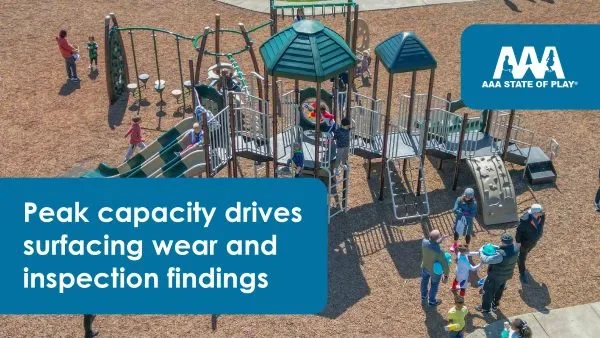
In public settings, capacity is judged through outcomes: congestion, conflict at access points, elevated maintenance, and more frequent corrective actions. When the play area is consistently beyond what circulation can absorb, supervision coverage becomes less effective and children begin to queue in fall zones. The earliest compliance stress test is often playground surfacing, because repetitive traffic concentrates at slide exits, transfer points, and the shortest path between high-demand events. Once wear patterns become routine, the site can shift from normal maintenance into repeated corrective work that is visible to inspectors, reviewers, and the public. Capacity issues become harder to defend after approval because fixes often affect circulation, accessibility, and surfacing scope.
The Conditions That Determine Whether Capacity Holds Up
Playground capacity planning holds up when the installed condition matches peak-use realities, and the project file explains the assumptions that shaped the layout. In practice, playground capacity planning is evaluated against the busiest periods, not the average week. In municipal review, outcomes are driven by whether the play space operates predictably at peak load, whether playground surfacing remains compliant in the highest-wear locations, and whether playground design documentation supports the installed condition that will be inspected.
Peak-load assumptions tied to program patterns
Capacity becomes unmanageable when planning a playground is based on average attendance, while the site actually experiences seasonal peaks, event surges, and school-release waves. Peak loads concentrate at gateways, ramps, slides, climbers, and any feature that creates a queue. A defensible file states the assumed peak window and the occupancy condition that the play area is intended to support. That is the only practical way to answer “how many children” without turning the question into a staffing debate. See ASTM F1487 explained for the public-use equipment baseline.
Circulation and zone separation for defined users
Capacity failures often reflect geometry, not intent. A playground structure that creates a single choke point—one ramp, one stair, one exit—invites queues into use zones. Even when equipment is labeled for an intended age range, the installed play space must separate users so higher-mobility children do not stack into the same corridor as smaller users. When the design intent includes specific age groups, separation and circulation should be documented as part of playground planning, not left to signage. For public review, it is more defensible to document “intended users” and circulation control than to rely on informal assumptions about behavior.
Surfacing performance under repetitive traffic
When capacity is reached, playground surfacing becomes the first recurring maintenance and inspection topic. Repetitive traffic displaces loose-fill systems, accelerates wear on unitary systems, and creates grade changes that affect accessibility and impact attenuation. Playground safety surfacing needs an explicit plan for how disturbed areas will be corrected and how performance will be revalidated, especially where water movement and traffic interact. This is a playground planning issue, not an after-award surprise. For inspection-facing documentation expectations, review the inspection process.
Installation quality and acceptance documentation
Even a compliant plan can fail if execution changes the installed geometry. Professional installation affects clearances, slopes, and transitions that change how children move through the play area. Under a procurement schedule, this is often treated as “install complete,” but inspectors evaluate the installed condition the same way regardless of delivery date. Under heavy use, small deviations become high-wear points, especially where borders, ramps, and drainage interfaces meet playground surfacing. The defensible approach is to treat turnover as an acceptance event: verify the installed condition, retain the key documents, and record who owns maintenance responsibilities for the play space.
Where Capacity Breaks First in the Installed Condition
Capacity-related failures are usually described as “heavy use,” but they repeat in consistent ways. The play area is sized to fit a footprint, but not to absorb peak crowd flow, creating congestion at entries and exits. The playground project is then managed as maintenance instead of as a scope problem. The surfacing scope is treated as an accessory, so playground surfacing is installed without defining how it will be maintained in the highest-traffic lanes, leading to recurring findings and spot repairs. Selecting playground equipment and layouts without circulation relief combines multiple high-demand events into one corridor, so children queue in use zones, and supervision lines are blocked. Existing equipment is retained without re-evaluating spacing and use zones, creating overlap once new play equipment is added. Over time, these conditions become framed as playground safety exposure because the record cannot show that peak-use conditions were anticipated and controlled.
The Documentation Conditions That Make Capacity Defensible
Capacity control becomes defensible when it is treated as a set of conditions the play space must meet at peak use. Playground capacity planning should be documented as the intended user condition, the assumed peak window, and the circulation paths that keep queues out of use zones. The playground planning file should also define how playground surfacing will be maintained and corrected in the highest-wear locations, including how drainage and traffic patterns will be addressed so standing water does not accelerate wear or change surface transitions. For projects where accessibility applies, the playground site documentation should show that the installed routes and transitions remain predictable under use, not only on day one.
What This Means for Parks and Facilities Leadership
For Parks & Recreation Directors and Public Facilities Managers, playground capacity planning is a procurement risk issue tied to inspection outcomes. When playground capacity planning is not documented, the total project cost often increases after approval through surfacing repairs, circulation changes, and additional supervision controls.
- Treat play area capacity as a documented peak-use assumption that can be defended under review.
- Require the playground project file to define how playground surfacing will be maintained and revalidated in the highest-wear zones, and confirm professional installation records support the intended slopes and transitions.
- Confirm that playground design documents show circulation relief and zone separation for intended users so queues stay out of use zones.
- If existing equipment remains, require a spacing and use-zone recheck so the combined play equipment does not create new conflicts across the play space.
- Keep playground planning language consistent so capacity is evaluated as a predictable public-use condition, not as a post-opening surprise.
Next Step
If you need a defensible reference point for acceptance documentation, ASTM F1487 requires written verification before first use and maintained installation/inspection records (ASTM F1487-25 Sections 11.2.2 and 13.3).