

In early childhood, parallel play is an important developmental stage that supports independence, confidence, and early social awareness. As toddlers grow and begin spending more time around peers, parallel play helps them adjust to shared environments while still engaging in independent activity.
Although children may not directly interact during this stage, parallel play contributes meaningfully to healthy emotional and social development.
What Is Parallel Play?
Parallel play is a stage of play in which children play alongside one another without directly interacting, sharing structured goals, or organizing their activity together. While children may observe or imitate each other, their play remains independent and self-directed.
This stage reflects growing social awareness. Children recognize the presence of peers and begin learning from observation, even if they are not yet ready to communicate or cooperate during play.
Parallel play is one of the recognized stages of play in early childhood development and is most common during the toddler years.
Benefits of Parallel Play
Parallel play supports multiple areas of early childhood development, including:
Confidence building: Children practice emerging skills independently while observing peers. As they master simple tasks like stacking blocks or turning pages, their confidence grows and encourages further exploration.
Preparation for group play: Playing near others helps children become comfortable in shared spaces, easing the transition from solitary play to more interactive stages.
Early social learning: Even without direct conversation, children observe, imitate, and respond to one another. These small interactions build foundational social skills.
Self-expression: Parallel play allows children to explore personal interests and play styles while still participating in a shared environment.
Emotional regulation: Playing beside others without pressure to interact can reduce overstimulation and help children manage sensory input more comfortably.
Examples of Parallel Play
Parallel play often appears quiet or independent, but meaningful developmental learning is taking place. Common examples include:
Two toddlers stacking separate block towers while sitting next to each other.
Children digging individually in the same sandbox.
Siblings coloring at the same table without sharing materials.
Toddlers climbing different parts of a playground structure at the same time.
Children pushing toy cars beside one another without coordinating their play.
In each example, children remain focused on their own activity while sharing space with peers.
Encouraging Parallel Play
Parallel play is naturally occurring and does not need to be forced. However, parents and caregivers can support this stage by creating opportunities for children to play near one another in comfortable, low-pressure environments.
Strategies to encourage parallel play include:
Providing duplicate toys to reduce conflict.
Creating defined play spaces that allow personal boundaries.
Allowing children to observe others without pressure to participate.
Offering open-ended materials such as blocks, sand, art supplies, or sensory tables.
Encouraging outdoor play in shared spaces like backyards or playgrounds.
Adults can support development by modeling calm social interaction and allowing children to engage at their own pace.
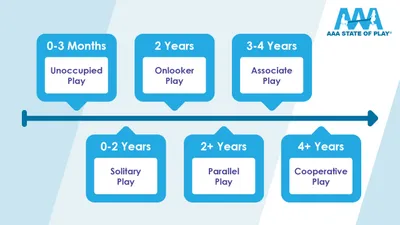
Parallel Play vs The Other Stages of Play
Opportunity to create a graphic that shows the relation and sequence of the other stages of play.
Unoccupied Play: Children explore movement and materials without a specific objective.
Solitary Play: Children play independently and focus entirely on their own activity.
Onlooker Play: Children observe others playing without participating.
Parallel Play: Children play alongside others using similar materials with limited interaction.
Associative Play: Children engage socially during play but without structured goals or assigned roles.
Cooperative Play: Children work together toward shared goals, establish rules, and collaborate to solve problems.
Movement between stages is gradual, and children may shift between stages depending on the environment and developmental readiness.