

Updated 10/2026
Most commercial playgrounds are built from four core playground equipment materials: galvanized or powder-coated steel, aluminum, high-density polyethylene (HDPE) plastic, and wood, with rope and textiles added for climbing features. Metal play structures last 25 to 50 years, quality plastics last 10 to 30 years, and rubber playground surfacing lasts 12 to 15 years with proper maintenance. Underneath it all sits the safety surfacing, which does more to prevent injuries than any other single component.
This guide walks through each material, how long it lasts, and how to match it to your site's weather conditions, budget, and playground use.
What materials are used for the main structure?
The main structure of most modern playgrounds combines metal for the frame and plastic for the play components. Each material does a specific job, and commercial playgrounds mix them rather than picking one.
Galvanized or powder-coated steel carries the highest load capacity and gives play structures their structural integrity. Steel posts and support frames are what let a deck hold a dozen kids at once, and the coating is what keeps them from rusting through.
Aluminum is lightweight and naturally rust-resistant, which makes it a strong choice for coastal sites or any location where salt and moisture attack steel faster.
Rotationally molded polyethylene shapes the slides, tunnels, and panels. Rotational molding produces a seamless, thick-walled part that handles constant use without cracking at the seams.
Wood provides natural aesthetics and blends into park settings where a steel frame would look industrial. It's common on nature-themed playground structures and borders.
Rope and textiles form net climbers and cable walks. These components flex under load, which is exactly what makes them appealing to older kids.
How long does each playground material last?
Lifespan varies widely by material, and it's the number that matters most when you're comparing two quotes on a 20-year horizon.
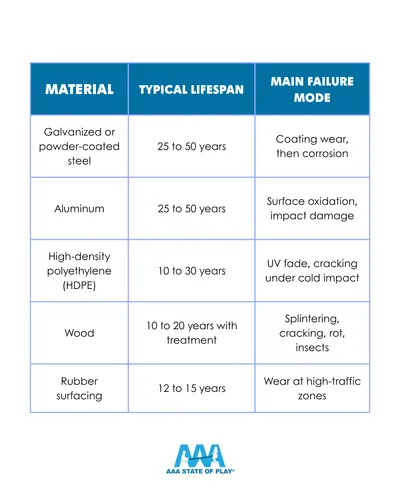
Metal playground equipment outlasts everything else on the site, which is why the structure usually outlives the slides bolted to it. Plastic components are the ones you'll replace mid-life, and that's normal rather than a sign of poor quality.
What materials are used for playground surfacing?
Playground surfacing splits into two families. Unitary surfaces are fixed, continuous systems, while loose-fill materials are poured in and raked level.
Poured-in-place (PIP) rubber is a seamless unitary surface installed wet and cured on site. PIP rubber can be customized for depth and color, which lets you match a brand palette or build a hopscotch course into the surface itself.
Rubber tiles deliver the same impact protection as PIP rubber in interlocking panels. Individual tiles can be swapped when one wears out, which keeps repair costs low.
Engineered wood fiber is the most cost-effective surfacing that still complies with ADA accessibility standards when it's installed and maintained properly.
Rubber mulch is a loose-fill option made from recycled rubber. It drains well and doesn't decompose the way wood fiber does.
Unitary surfaces cost more upfront but stay level under heavy use, which matters for wheelchairs, walkers, and other mobility aids that sink into loose fill. Loose-fill surfacing is cheaper to install and easy to top off, but it displaces at swing exits and slide landings and needs regular raking to keep a safe landing area at the required depth.
How does surfacing material affect playground safety?
Safety surfacing underneath playground equipment is the single most important factor in injury prevention, because falls cause the majority of playground injuries. The surface has to provide impact attenuation rated to the equipment's fall height under ASTM F1292, not just cover the surface area with something soft.
Loose-fill material typically needs 12 inches of depth to hold that rating, and it loses protection as it compresses. Unitary surfaces hold their rating until they physically wear through, which is part of why they carry a longer service life. Effective drainage matters for both: standing water accelerates wear on rubber and causes wood fiber to compact and rot.
What safety standards apply to playground materials?
ASTM F1487 and the Consumer Product Safety Commission (CPSC) Public Playground Safety Handbook together set the safety standards for public play equipment. They cover entrapment openings, which must measure under 3.5 inches or over 9 inches, and the 6 ft use zone that gives a child a safe landing area around stationary equipment.
Material choice intersects with those rules in ways that aren't obvious. Unprotected metal surfaces can become hot enough in direct sunlight to cause contact burns, which is why slides and decks use plastic or coated metal rather than bare steel. Rubber components can also heat up in sunlight and degrade over time. Wood runs cooler by comparison, since it requires temperatures around 99 degrees C to cause a burn.
Which materials hold up best to weather and heavy use?
Plastic and coated metal handle weather conditions with the least intervention. Plastic is low maintenance, resists mold and mildew damage, and won't splinter or rust, which makes it a strong fit for humid climates and for any site without a dedicated grounds crew.
Wood needs the most attention. It can splinter, crack, or rot if it isn't sealed on schedule, and untreated wood can harbor insects. That doesn't rule it out, since wood is still the right call when a design needs to blend into a park setting, but it should come with a maintenance plan attached rather than being specified on looks alone.
What maintenance does each material need?
Daily inspections catch issues early on every material, and they take only a few minutes per structure. Staff should look for loose hardware on metal, cracks in plastic components, and splinters or soft spots on wood, plus surfacing that's thinned out below depth in high-traffic zones.
The installation process sets the ceiling on all of it. Footings poured to spec and surfacing installed to the right depth are what ensure longevity, since no maintenance schedule recovers a structure that was anchored incorrectly on day one.
Proper care extends service life substantially. Rubber surfacing reaches the top of its 12-to-15-year range only when it's cleaned and patched on schedule, and play structures reach the top of theirs when coatings get touched up before corrosion starts. Maintained properly, the materials above hit their published lifespans. Neglected, most of them fail in half the time.
How do you choose materials for your play space?
Start with what the site demands. Coastal and high-UV locations favor aluminum and HDPE, heavy-use school sites favor unitary surfaces over loose fill, and tight budgets stretch further with engineered wood fiber and freestanding playground equipment rather than a full modular system.
Accessibility narrows the field further. If you're serving children who use wheelchairs or other mobility aids, a firm, stable unitary surface paired with accessible equipment is what makes the play space usable rather than just compliant. Adequate spacing between a structure and nearby swing sets matters too, since the swing use zone extends much further than the 6 ft required around stationary equipment.
Choose the right playground equipment materials with AAA State of Play
If you're specifying materials for a new playground or replacing components on an existing playground, AAA State of Play can help you match equipment and surfacing to your site, budget, and climate. Contact us today for a free consultation!