

Buyer: Parks & Recreation Directors, Parks Superintendents, Municipal Operations Managers, Public Facilities Managers
Primary Risk: Inspection delays, rework, change orders, and approval exposure caused by scope assumptions hidden behind “turnkey” language
Applies to: ASTM F1487 (public-use equipment), ASTM F1292 (impact attenuation), CPSC Public Playground Safety Handbook, DOJ 2010 ADA Standards (where applicable)
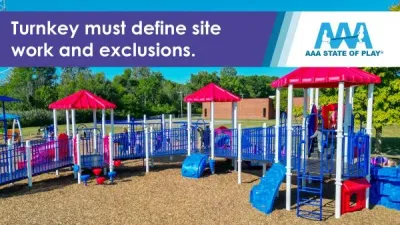
The Scope Gap Hidden in a “Turnkey Playground”
For Parks & Recreation Directors and Municipal Operations Managers—and in some cases schools with shared facilities governance—“turnkey playground” is often treated as a simple procurement label: one vendor, one package, one timeline. In municipal environments, that assumption becomes risky because “turnkey” is not a defined scope standard. It is a commercial term that can be used to describe anything from playground equipment only to full site delivery, depending on how the vendor writes the quote and how the project is bid. In many proposals, “turnkey” also gets paired with brochure language like “turnkey solutions,” “play solutions,” or even “fun” outcomes, none of which define what is actually included for approval and inspection.
The practical problem is not whether a turnkey playground can be delivered. The problem is whether the term is doing real scope work on paper. If “turnkey” is not translated into a documented list of included work and assigned responsibilities, the approving authority is left with gaps that typically surface later—during submittal review, professional installation, or inspection—when flexibility is lowest and public scrutiny is highest.
Why the Gap Shows Up at Review and Inspection
Public playground outcomes are evaluated on installed condition, not on intent. Reviewers and inspectors evaluate fall zones, surfacing performance, accessible routes and play opportunities, site interfaces, and hazards in the fully installed state. A “turnkey” label does not change what must be compliant under ASTM, CPSC, and ADA expectations, where applicable.
When a turnkey playground is awarded without a clear scope boundary, exclusions become discoveries rather than decisions. Discoveries drive change orders, schedule slips, and rework after funds have been committed and public communications have already started. This is also where internal accountability becomes unclear: staff may believe the vendor is responsible because the contract says “turnkey,” while the vendor may point to exclusions or “by others” language when site conditions or supporting work are required.
What Determines Whether a Turnkey Playground Holds Up
“Turnkey” Only Works When the Installed Condition Is Defined
A turnkey playground is defensible when “turnkey” is treated as an installed-condition commitment with a written scope boundary. That means the procurement file can answer basic questions without interpretation: what is being built, what systems are included, what work is excluded, and who is responsible for each interface. A one-line “turnkey” description does not carry that burden.
Municipal outcomes depend on what is documented, not what was implied. If playground equipment, surfacing, installation, and site modifications are not listed as line-item scope (with responsibilities assigned), “turnkey” becomes a placeholder that cannot support plan review, inspection review, or post-award explanation when something was assumed but not included.
Site Work Interfaces Decide Whether “Turnkey” Holds Up
In many communities, the largest exclusions are not related to play structures. They sit in the civil and site interface layer: demolition and disposal, grading, drainage correction, concrete and borders, utilities and lighting impacts, fence or gate work, shade structure foundations, and path connections to surrounding circulation.
A turnkey playground that excludes the work required to make the site install-ready is still a split-scope project. It simply hides the split until the installer arrives or the inspector evaluates the final condition. In municipal delivery, the approving authority is effectively reviewing a site modification, not only an equipment purchase. If the vendor’s “turnkey” scope is not aligned to that reality, delays typically occur at the handoff between playground equipment delivery and “site readiness,” including on projects delivered through schools, where site constraints and sequencing are more controlled.
Compliance Documentation Must Match the Exact Configuration
Public-use playground compliance is evaluated against the configuration that is installed, not a catalog claim. Whether the project is marketed as turnkey or not, the compliance record needs traceability: equipment documentation that corresponds to the plan, surfacing documentation that corresponds to the installed depth and system, and accessibility documentation that corresponds to routes and play opportunities where ADA applies.
This is where turnkey proposals often become thin. A turnkey playground can still fail review if submittals do not match what was bid, if surfacing documentation is generic rather than system-specific, or if accessibility is claimed without a documented route-and-activity system. Where commercial playground equipment is being procured, the expectation should be that documentation ties to the exact configuration being purchased and installed. In municipal environments, “close enough” paperwork is treated as a quality problem because reviewers cannot approve what they cannot verify. (Internal authority reference: ASTM F1487 Explained.)
Acceptance, Permitting, and Closeout Are Part of the Risk, Even When “Turnkey” Is Used
Municipal buyers often assume “turnkey” includes permitting support, inspection coordination, and closeout documentation. Many proposals do not. Approval and acceptance typically require more than installation completion: defined use zones, verified surfacing conditions, accessible routes where applicable, and a closeout file that can be retained for future questions.
If the turnkey playground scope does not state who is responsible for permits, inspections, as-builts, warranty registrations, maintenance materials, and corrective work identified during the final walk-through, the municipality inherits administrative risk. That risk becomes real when opening is delayed, when the site requires corrections, or when staff is asked to explain why acceptance occurred without a complete record. This matters in schools as well, where audits and internal controls often require documentation continuity and consistent quality of closeout files.
Common Breakdown Points in Turnkey Playground Packages
Municipal turnkey playground projects most commonly break down in predictable ways:
- “Turnkey” is defined at a high level, but demolition, disposal, or removal of existing surfacing is excluded, creating immediate change orders once work begins.
- Surfacing is included, but the base, drainage preparation, transitions, borders, or required depths are treated as “by others,” resulting in failed impact performance or rework at closeout.
- Accessibility is referenced as a label, but the accessible route, connection to existing circulation, and the mix of accessible play opportunities are not defined in scope language.
- Concrete work (footings, curbs, ramps, foundations for shade or other elements) is assumed rather than assigned, delaying installation sequencing and inspections.
- Submittals do not match the bid configuration, forcing resubmission and re-approval after award, when schedule commitments have already been communicated.
How to Specify “Turnkey” Without Inheriting the Risk
A turnkey playground procurement becomes defensible when “turnkey” is treated as a scope definition, not a sales descriptor. The project file should read as a responsibility map for the installed condition: included work, exclusions, and the party accountable for each interface (site readiness, demolition, concrete, surfacing system components, accessibility connections, permits, and closeout records). When standards apply, documentation should be configuration-specific and aligned to the plan set so reviewers can verify compliance without interpretation.
If the municipality cannot point to a written scope boundary that survives plan review and inspection review, the project is not truly turnkey. It is simply bundled procurement language applied to a multi-scope site project.
What This Means for Parks and Facilities Decision-Makers
For Parks & Recreation Directors and Municipal Operations Managers, “turnkey playground” should be evaluated as a documentation and scope-control issue, not a convenience feature.
- Treat “turnkey” as an installed-condition commitment that must be definable in the procurement file.
- Expect the highest risk in excluded interfaces: demolition, civil work, concrete, drainage, and route connections.
- Require configuration-matching compliance documentation (equipment, surfacing, and accessibility where applicable).
- Assuming approval and acceptance will evaluate the whole site condition, regardless of how the vendor labels the package.
- If responsibilities are not assigned on paper, the municipality becomes the default risk holder after the award.
Next Step
If you need a defensible closeout benchmark for a turnkey playground, ASTM F1487-25 requires written installation verification and maintained records (see Sections 11.2.2, 11.3.1, 13.3).